
In modern electrical and industrial installations, cable glands play a vital role in protecting cables, maintaining enclosure integrity, and ensuring the safety of electrical systems. However, not all cable glands are designed for the same purpose. While standard cable glands are widely used in general electrical applications, EMC (Electromagnetic Compatibility) cable glands are specifically engineered for environments where electromagnetic interference (EMI) could affect equipment performance.
Choosing between an EMC cable gland and a standard cable gland depends on several factors, including cable type, installation environment, and electromagnetic compatibility requirements. This guide explains the differences, advantages, applications, and selection criteria to help you choose the right solution for your project.
What Is a Standard Cable Gland?
A standard cable gland is a mechanical cable entry device used to securely attach and seal a cable where it enters an electrical enclosure, junction box, control panel, or piece of equipment.
Its primary functions include:
- Providing strain relief to prevent cable pull-out
- Protecting cables from mechanical damage
- Sealing cable entry points against dust, moisture, and contaminants
- Maintaining the enclosure’s IP (Ingress Protection) rating
- Improving cable management and installation safety
Standard cable glands are suitable for most commercial, industrial, and residential electrical installations where electromagnetic shielding is not required.
Common Materials
Standard cable glands are manufactured from various materials to meet different environmental requirements, including:
- Nickel-plated brass
- Stainless steel
- Polyamide (Nylon)
- Aluminum
- Plastic
The material selection depends on factors such as corrosion resistance, mechanical strength, operating temperature, and installation environment.
What Is an EMC Cable Gland?
An EMC cable gland is a specialized cable gland designed to provide both environmental sealing and electromagnetic shielding.
Unlike a standard cable gland, an EMC cable gland establishes a low-resistance electrical connection between the cable shield (braid or foil) and the metal enclosure. This continuous conductive path allows electromagnetic interference to be safely directed to ground, minimizing unwanted electrical noise.
EMC cable glands are commonly used with shielded cables in applications involving sensitive electronic equipment or high-frequency electrical systems.
Why Electromagnetic Compatibility Matters
Electromagnetic Compatibility (EMC) refers to the ability of electrical equipment to operate correctly without generating excessive electromagnetic interference or being affected by interference from nearby devices.
Modern industrial systems often include:
- Variable Frequency Drives (VFDs)
- PLC control systems
- Servo motors
- Industrial automation equipment
- Communication networks
- Medical devices
- Measurement instruments
- Data transmission systems
These systems produce and receive electromagnetic signals. Without proper shielding, EMI can lead to:
- Communication errors
- Data loss
- Sensor malfunctions
- Equipment instability
- Unexpected downtime
- Reduced system reliability
EMC cable glands help preserve signal integrity and improve the overall performance of electrical systems.
How EMC Cable Glands Work
Shielded cables contain a metallic braid or foil designed to block electromagnetic interference. However, the shielding is only effective when it is properly terminated.
An EMC cable gland creates direct electrical contact with the cable shield using conductive components such as:
- Contact springs
- Grounding cones
- EMC clamps
- Conductive rings
- Shield contact inserts
Once installed, the conductive path is:
Cable Shield → EMC Cable Gland → Metal Enclosure → Ground
This grounding path safely dissipates electromagnetic energy and maintains shielding continuity.
EMC vs Standard Cable Glands: A Detailed Comparison
| Feature | Standard Cable Gland | EMC Cable Gland |
|---|---|---|
| Mechanical cable retention | ✔ | ✔ |
| Strain relief | ✔ | ✔ |
| Dust and water sealing | ✔ | ✔ |
| Maintains IP rating | ✔ | ✔ |
| Shield grounding | ✘ | ✔ |
| EMI/RFI protection | ✘ | ✔ |
| Suitable for shielded cables | Limited | Excellent |
| Electrical continuity | No | Yes |
| Installation complexity | Simple | Moderate |
| Cost | Lower | Higher |
Although both cable glands protect cable entry points, EMC cable glands offer an additional layer of protection against electromagnetic interference.
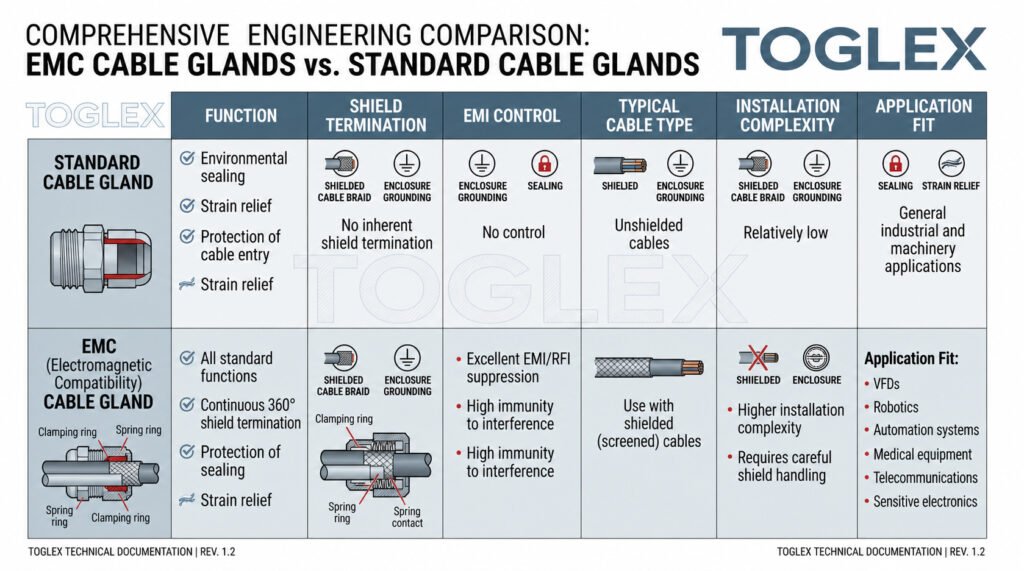
Structural Differences
Standard Cable Gland Components
A typical standard cable gland consists of:
- Locknut
- Gland body
- Compression nut
- Sealing ring
- Rubber seal
These components provide mechanical retention and environmental sealing but do not interact with the cable shield.
EMC Cable Gland Components
In addition to the standard components, EMC cable glands include conductive elements such as:
- EMC contact spring
- Grounding cone
- Shield clamp
- Conductive contact ring
- Metallic insert
These components ensure reliable electrical contact with the cable shielding while maintaining mechanical protection.
Advantages of Standard Cable Glands
Standard cable glands remain the preferred choice for many general-purpose applications due to several advantages.
Cost-Effective
They are generally less expensive than EMC cable glands, making them ideal for projects with limited budgets.
Easy Installation
No special preparation of the cable shield is required, reducing installation time.
Versatile
Standard cable glands are available in a wide range of thread types, sizes, and materials to suit different installation requirements.
Reliable Environmental Protection
When properly installed, they provide excellent protection against water, dust, and environmental contaminants.
Advantages of EMC Cable Glands
EMC cable glands provide all the benefits of standard cable glands while offering additional electrical protection.
Excellent EMI Shielding
They maintain continuous shielding between the cable and enclosure, reducing electromagnetic emissions.
Improved Signal Integrity
Proper shield termination minimizes electrical noise, ensuring stable communication and accurate signal transmission.
Increased Equipment Reliability
Reducing EMI helps prevent unexpected equipment failures and operational interruptions.
Compliance with EMC Standards
Many industries require compliance with EMC regulations. EMC cable glands help manufacturers and installers meet these requirements.
Typical Applications
Standard Cable Glands
Standard cable glands are commonly used in:
- Residential electrical systems
- Commercial buildings
- Lighting installations
- Power distribution panels
- HVAC equipment
- Water treatment plants
- General industrial machinery
These applications generally involve non-shielded cables and minimal electromagnetic interference.
EMC Cable Glands
EMC cable glands are recommended for installations using shielded cables or operating in high-interference environments.
Typical applications include:
- Industrial automation systems
- Robotics
- CNC machinery
- Variable frequency drives
- Railway signaling
- Renewable energy systems
- Wind turbines
- Solar power installations
- Telecommunications
- Data centers
- Medical equipment
- Laboratory instruments
- Control cabinets
- Instrumentation systems
Installation Considerations
Installing a standard cable gland is relatively straightforward:
- Select the correct gland size.
- Insert the cable.
- Tighten the compression nut.
- Secure the gland to the enclosure.
- Verify the sealing performance.
Installing an EMC cable gland requires additional care:
- Strip the outer cable jacket.
- Expose the cable shield without damaging it.
- Position the shield over the grounding component.
- Assemble the gland according to the manufacturer’s instructions.
- Tighten to the recommended torque.
- Test electrical continuity between the shield and enclosure.
Improper installation may reduce EMC effectiveness even if the cable gland itself is of high quality.
How to Choose the Right Cable Gland
Before selecting a cable gland, consider the following questions.
Is the cable shielded?
If the cable includes a metallic braid or foil shield, an EMC cable gland is usually the best choice.
Is EMI a concern?
Installations involving electronic controls, communication systems, or precision instruments benefit from EMC protection.
Does the project require EMC compliance?
Industries such as automation, transportation, telecommunications, and medical equipment often require EMC-certified installations.
What is the installation environment?
General electrical installations typically require only standard cable glands, while harsh industrial environments with high electromagnetic noise call for EMC cable glands.
What is the budget?
Although EMC cable glands have a higher initial cost, they can reduce maintenance costs and improve long-term system reliability.
Common Installation Mistakes
Avoid these common errors during installation:
- Selecting the wrong cable gland size
- Damaging the cable shield
- Failing to establish proper grounding
- Over-tightening or under-tightening the gland
- Using standard cable glands for shielded cables in high-EMI environments
- Ignoring manufacturer torque specifications
Following correct installation practices ensures both mechanical protection and effective electromagnetic shielding.
Frequently Asked Questions
Can a standard cable gland be used with a shielded cable?
Yes, but the shield will not be properly grounded. This significantly reduces the effectiveness of the cable’s electromagnetic shielding.
Are EMC cable glands waterproof?
Yes. Most EMC cable glands offer the same IP protection ratings as standard cable glands while also providing electromagnetic shielding.
Do EMC cable glands require a metal enclosure?
For optimum EMC performance, the gland should be installed on a conductive, properly grounded metal enclosure to ensure continuous electrical contact.
Are EMC cable glands more expensive?
Generally, yes. Their additional conductive components and more complex design make them more costly than standard cable glands. However, the added protection often justifies the investment in sensitive applications.
Conclusion
Both EMC cable glands and standard cable glands provide secure cable entry, strain relief, and environmental sealing, but they serve different purposes.
Standard cable glands are ideal for general electrical installations where electromagnetic interference is not a significant concern. They are cost-effective, easy to install, and suitable for most non-shielded cable applications.
EMC cable glands, on the other hand, are specifically designed for shielded cables and environments where maintaining electromagnetic compatibility is essential. By ensuring continuous grounding of the cable shield, they reduce EMI, improve signal integrity, enhance equipment reliability, and support compliance with EMC standards.
When selecting a cable gland, always consider the cable construction, operating environment, system requirements, and applicable industry standards. Choosing the correct cable gland not only protects your electrical installation but also contributes to the long-term performance and safety of your entire system.